
BFT Gate Repair in Arleta: A Homeowner’s Guide
BFT gate repair in Arleta usually comes down to one of three things: a control board that has logged a fault and stopped responding, an encoder that has lost its position reading, or a safety sensor that has drifted out of alignment. Most BFT operators don’t actually have a dead motor when they stop working, even though that’s the most common misdiagnosis we see. If you’d rather not open the cover yourself, call (855) 473-3106 and we’ll walk through what you’re seeing.
We’re going to cover what actually fails on BFT operators in Arleta’s dry, dusty conditions, how to read the LED codes before you call anyone, and why the fault history stored in the board matters more than whatever symptom showed up this morning. Nothing here requires you to touch high-voltage wiring. If a step starts to feel uncomfortable, stop and call us. We answer 24/7. Fast dispatch from 7am to 7pm, Sunday through Friday.
Why BFT Operators Behave Differently Than Other Gate Brands
BFT builds its residential and commercial operators around an encoder-based feedback system. The motor reports its exact position back to the control board hundreds of times per revolution. That’s different from a basic limit-switch system, where the opener just runs until it hits a physical stop. BFT’s approach gives you precise soft-start and soft-stop behavior, and it’s why a properly calibrated BFT gate moves smoothly instead of jolting.
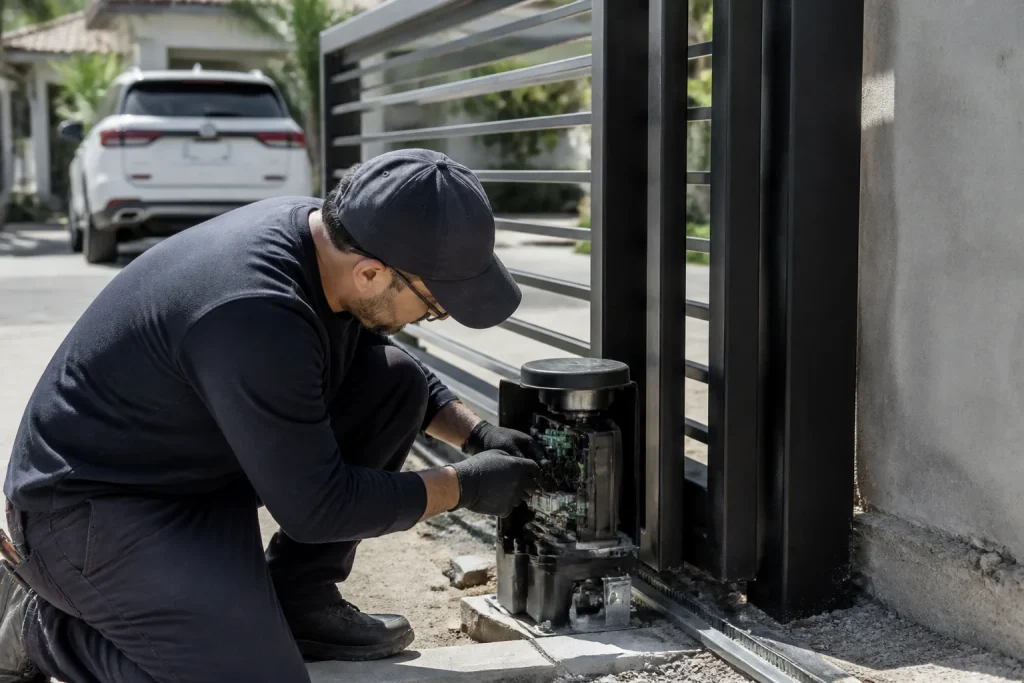
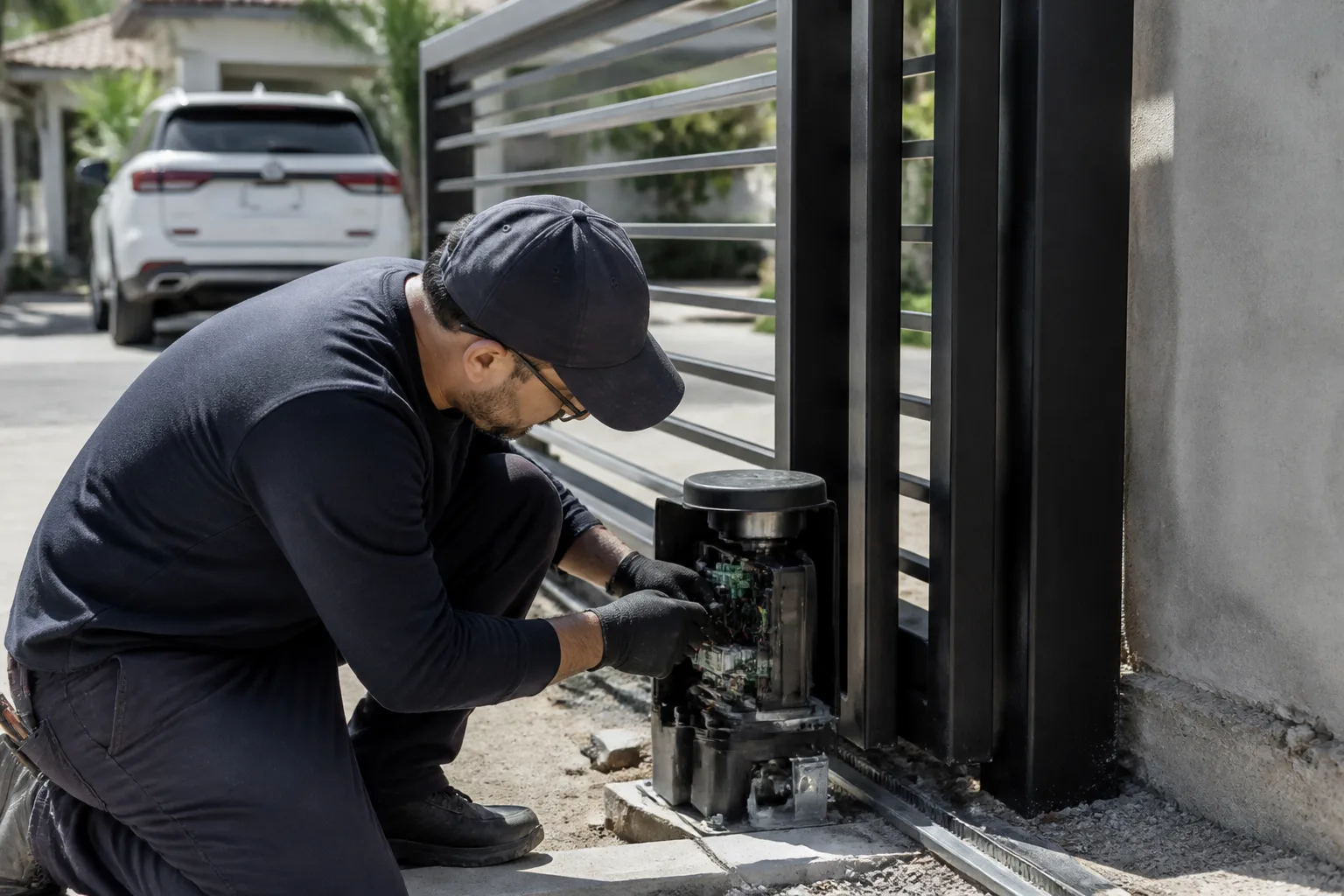
But that same precision creates a failure mode most Arleta homeowners aren’t prepared for. When the encoder disk inside the operator gets dusty, or the reader slips a millimeter out of alignment, the board no longer knows where the gate is. The motor is usually fine. The board is usually fine. Yet the gate won’t move, or it moves six inches and reverses. A technician who isn’t BFT-fluent will often condemn the motor or the board when the actual fault is a $3 encoder disk that takes twenty minutes to clean and reseat.
We work across nine major gate brands, including LiftMaster, FAAC, BFT, Linear, Viking, Ghost Controls, DoorKing, Elite, and Mighty Mule. That matters for BFT owners because we’re not approaching your system as a mystery box. We know which BFT models share parts, which control boards store which fault codes, and which symptoms point to the encoder versus the travel limits. Your system, diagnosed correctly the first time.
If your gate is doing something strange, the first thing we’d suggest is noting exactly what the operator does on each open and close cycle. Does it always stop at the same point? Does it reverse immediately, or after a delay? Does the LED on the board flash a pattern? Those details save a diagnostic visit from turning into guesswork.
Reading BFT LED Blink Codes on DEIMOS and MERAK Series
Most BFT DEIMOS and MERAK control boards have a small LED that blinks in specific sequences to tell you what the board thinks is wrong. You don’t need to be a technician to read them. You need to know that the pattern exists, and that it’s stored, and that writing it down before you call anyone helps.
Here’s the general approach. Open the control box cover only if you can do so without touching any wiring. Find the diagnostic LED on the board. Count the blinks before the pause. Write the sequence down. Close the cover. That’s it. You’re not repairing anything; you’re gathering information.
Common patterns on DEIMOS boards include a repeating single blink, which often points to a photocell or safety edge circuit that’s open, and a repeating double blink, which usually means the board has lost its travel-limit memory. On MERAK operators, a sequence that includes a long pause can indicate an encoder read failure rather than a physical obstruction. These distinctions are exactly where BFT-specific experience pays off. We’re not swapping a board to “see if it fixes it.” We read the stored fault first.
The bigger point is that BFT stores fault history in the control board memory. A generic gate technician who never accesses that log is flying blind. They’ll see a gate that won’t open, assume the motor or board is bad, and replace an expensive component while the actual logged fault was a wiring glitch from a loose molex connector. Then the gate works for a week because everything got reseated, and fails again. That’s not a repair; it’s an accident with an invoice attached.
If you’re in Arleta and your gate is flashing codes, call (855) 473-3106 and tell us exactly what the LED is doing. We answer 24/7. Fast dispatch from 7am to 7pm, Sunday through Friday. Free estimates, and the price is quoted and agreed before any work starts.
Obstacle Detection Sensitivity and Arleta Wind Events
BFT operators include obstacle detection that monitors motor current draw. When the gate meets resistance, the current spikes, and the board reverses the gate to prevent damage or injury. The sensitivity is adjustable, and here’s the thing most Arleta homeowners don’t know: it can be set too tight.
During a windy stretch, a solid metal gate acts like a sail. As gusts push against the gate, the operator has to work harder to maintain speed. If the sensitivity is calibrated too aggressively, the board interprets that extra motor load as an obstruction. The gate stops mid-travel or reverses and reopens. The homeowner checks for a rock in the track, finds nothing, and calls a technician. The technician shows up on a calm day, the gate works fine, and everyone is confused. That’s a false stop from wind loading, not a mechanical fault.
The fix is usually a sensitivity adjustment, not a part replacement. On some BFT models, you can change the setting from the keypad or a dip switch bank. On others, it requires entering the programming menu. If you’re not comfortable navigating the programming, that’s a reasonable time to call us. This kind of adjustment takes minutes, but doing it wrong can leave the gate too insensitive to stop for an actual obstruction, and that’s a safety issue you don’t want to guess at.
Arleta’s inland valley weather doesn’t bring snow or ice, so you’re not dealing with freeze-related gate problems. But dust is a real factor. BFT operators are sealed, but over years, fine dust can work into the encoder housing and the limit-switch area. The encoder is the most common victim. If your BFT gate has been reliable for years and suddenly starts stopping at random points, dust on the encoder disk is a strong candidate. This is one of the most common repairs we perform for BFT systems in Arleta.
The Programming Gap: What a Dealer Can Do vs. What You Can Access
BFT separates its operator programming into installer-level and dealer-level menus. The installer menu covers the basics: travel limits, auto-close timing, obstacle sensitivity, and remote programming. The dealer menu goes deeper, including torque curves, encoder calibration offsets, and specific diagnostic functions. Most Arleta homeowners only ever need the installer menu, and a competent independent technician can handle that without any authorized-dealer credentials.
But there’s a real gap. Certain BFT faults, especially encoder faults on some commercial-grade models, won’t clear properly without accessing the dealer-level diagnostic routine. An authorized BFT dealer can run a full encoder re-learn and store a new baseline. A technician who isn’t familiar with BFT’s menu structure might replace the encoder assembly entirely because they can’t figure out how to calibrate the one that’s already there. That’s a more expensive repair for the same outcome.
We’re independent. We’re not a BFT dealer, and we don’t pretend to be. But we are BFT-fluent, and we’ve spent years learning the quirks of DEIMOS, MERAK, VIRGO, and other BFT series. We know what the installer menu can do, what requires deeper programming, and when a part actually needs replacement versus when it just needs to be re-taught. If a gate needs dealer-only access, we’ll tell you that plainly instead of attempting a workaround that creates a new problem.
In the broader brand picture, BFT sits alongside commercial-grade names like DoorKing, Elite, and LiftMaster. BFT tends toward tighter tolerances and more precise motion control than entry-level residential openers like Mighty Mule. If you came from a Mighty Mule system and upgraded to BFT, the difference in feel is noticeable. But the complexity also means a technician who only works on simple residential openers is likely to misread a BFT fault.
BFT Battery Backup: What It Does and Doesn’t Do During an Outage
Some BFT operators include or accept a battery backup module. During a power outage, the battery keeps the control board and, on many models, the motor operating at reduced speed or for a limited number of cycles. BFT’s backup behavior is designed for occasional outages, not extended off-grid operation. The gate isn’t going to run at full speed indefinitely on battery power, and on some models the auto-close function is disabled while on battery to conserve charge.
What homeowners in Arleta often misunderstand is what the battery doesn’t do. It doesn’t keep accessories like lights, intercoms, or magnetic locks running at full capacity. It doesn’t protect against voltage sags that damage the control board before the battery takes over. And a battery that’s more than two or three years old in Arleta’s summer heat may test fine on the bench but fail under load. If your BFT gate works on battery and then dies halfway through a cycle, the battery may be the problem even if it reads 12 volts with no load.
If you’re considering a battery backup for a new BFT installation, ask about the model’s specific backup behavior before you buy. Some BFT operators accept an external battery module; others need a factory tray. We can help you sort that out without overselling you a unit that won’t do what you expect. If you already have a BFT gate in Arleta and it’s not behaving during outages, we can test the battery under load rather than just checking voltage. That’s the difference between replacing a good battery and replacing the actual problem.
When to Call a Pro
Reading an LED code and writing it down is one thing. Opening the operator housing and touching wiring is another. Here’s our honest bright line: if the problem is inside the control box, or if the gate is heavy enough to hurt someone if it slips, call a professional. A slide gate that comes off its track under power can cause serious injury. A control board with exposed capacitors can hold a charge. This isn’t the place to learn by doing.
Related services in Arleta: if your BFT operator is beyond reasonable repair, we handle gate installation as well, so you’re not bouncing between a repair company and an install company. And if the problem turns out to be wiring or an operator on a different brand, our electric gate repair page covers the full scope. Our core focus from the start has been gate repair, and BFT is one of the brands we work on most.
The Bottom Line
BFT operators are built with tighter tolerances than most residential gate brands. That makes them smooth and precise when calibrated correctly, and it makes them easy to misdiagnose when they’re not. The encoder feedback system, the stored fault history, and the adjustable obstacle sensitivity are the three places where a BFT gate repair in Arleta either goes right the first time or turns into a frustrating parts-swapping exercise.
Here’s what to remember:
- Read the LED blink code before you call anyone. Write it down.
- If the motor was replaced and the gate still fails, suspect the encoder disk or reader, not the new motor.
- Wind in Arleta can trigger false obstacle stops on a BFT gate. Check for physical obstructions, then consider sensitivity calibration.
- Fault history is stored in the board. A technician who doesn’t read it is guessing.
- Battery backup is for occasional outages, not extended off-grid use, and Arleta heat shortens battery life.
If you’re in Arleta and need help with a BFT gate, Gate Repair Arleta offers free estimates. Call (855) 473-3106. We answer 24/7. Fast dispatch from 7am to 7pm, Sunday through Friday. The price is quoted and agreed before any work starts, so you’ll know exactly what the repair costs before we touch a thing.
Frequently Asked Questions
The most common BFT failure we see in Arleta is an encoder fault, not a motor failure. Arleta’s dust gets into the encoder housing over time and the board loses its position reading, which makes the gate stop or reverse unpredictably. The motor is usually fine, and the fix is often a cleaning and recalibration rather than a full motor replacement.
BFT gate repair in Arleta is priced per job by a written estimate after we diagnose the gate, because the cost depends on whether the fault is an encoder, a board, a safety edge, or something else. The estimate is free, and the price is quoted and agreed before any work starts. Call (855) 473-3106 and we’ll come take a look.
In most cases, yes. We answer 24/7 and dispatch from 7am to 7pm, Sunday through Friday. If your BFT gate is stuck open or closed, call (855) 473-3106 and we’ll get a technician out as soon as possible. Some repairs need a part we don’t carry on the truck, and we’ll tell you that honestly before you commit to anything.
No, you don’t need a dealer for most BFT repairs. Installer-level programming covers travel limits, sensitivity, and auto-close timing, and an independent gate specialist can handle all of that. Dealer-level programming only matters for certain encoder calibration routines and deeper diagnostics, and if your gate needs that, we’ll tell you plainly rather than guessing through the installer menu.
Written by the team at Gate Repair Arleta, serving Arleta since 2018.
Need Gate Repair Help?
Call Gate Repair Arleta - licensed & insured, here with fast help in Arleta.
(855) 473-3106